
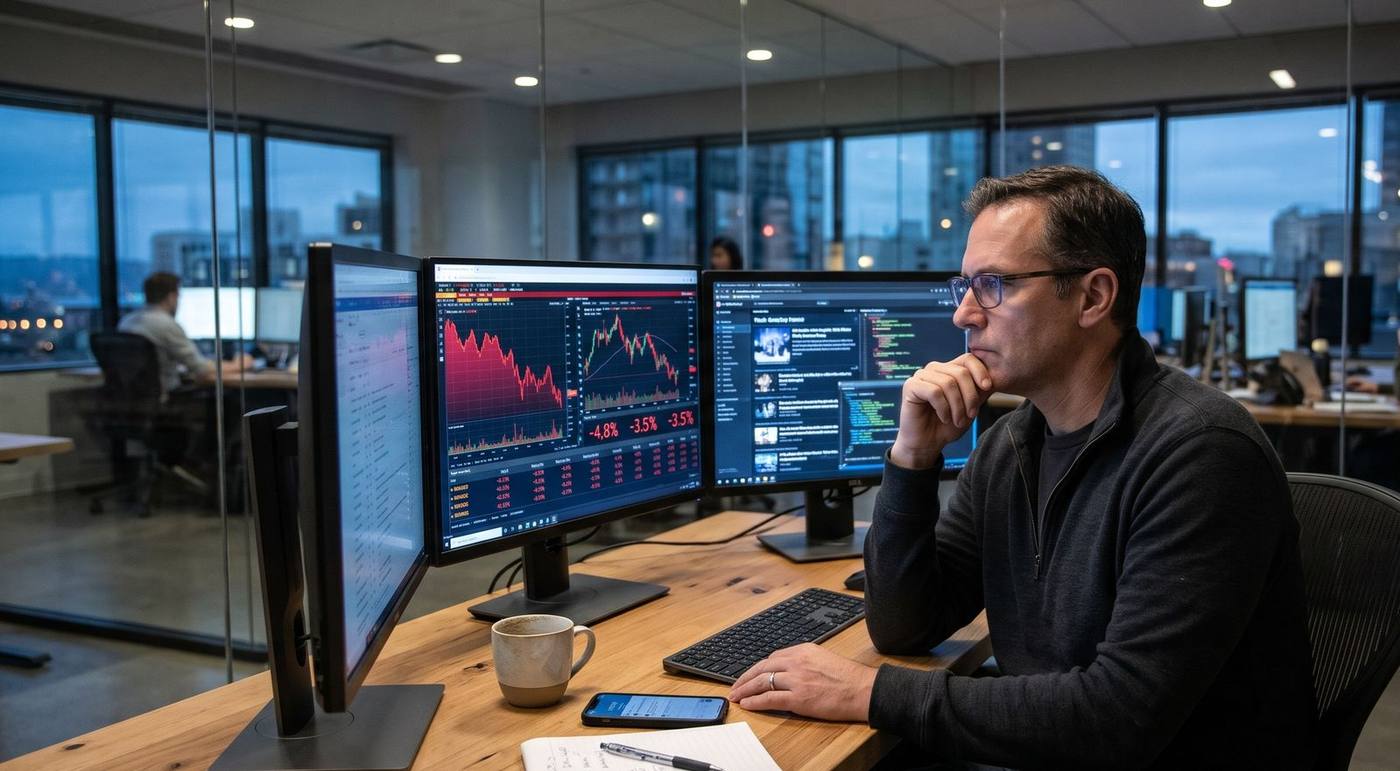
Last week, Dow Jones lost 8%, Nasdaq composite lost 10% for their worst week since March 2020. The Nasdaq composite turned negative for the year. S&P 500 index was down 8.6%, its worst week since April 2025. VIX hit its highest levels since March. Anthropic closed its first trading day Thursday at US$97.17, 17% above its IPO price, then slid 10% to roughly US$87 Friday. Amazon will own 14.7% (23.8% if it converts all its notes) and Google 13.7%. The year's 10 biggest IPOs are down an average of 20.5% from their offer prices. Nvidia raised its fiscal 2028 revenue growth forecast to 75%. October-quarter revenue more than doubled to US$116 billion, gross margin reached 74.8% and free cash flow nearly doubled to US$43.8 billion. However, accounts receivable roughly tripled, the 10-Q will be weeks late. NVDA stock is down nearly 30% over the past month. The board said it will not reinstate Jensen Huang, and its recruiter has approached Arm CEO Rene Haas. A new Commerce Department rule bars Chinese firms from using advanced U.S. chips in overseas data centres. Tencent and Alibaba warned these restrictions will delay model training. AMD fell 9% after a Hunterbrook short report alleged ties to a blacklisted Chinese server maker. SpaceX closed a US$32 billion off-balance-sheet debt deal at yields above 8% to fund US$47.3 billion of Nvidia GPUs. CrowdStrike is in talks to buy US$32 billion Zscaler. Palo Alto Networks agreed to acquire Applied Compute for US$4.5 billion in stock. In news pertaining to Sophic clients, Intermap grew Q3 revenue 5% to US$1.8 million and closed its US$7.7 million acquisition of PCI Geomatics. The Company guided to 2027 revenue of US$12-15 million with roughly US$5 million in Adjusted EBITDA. 01 Quantum and qLABS announced the Mythos Challenge: qLABS will publish the conventional private key of a wallet holding about US$100,000 in qVAULT-protected assets and invite the public to try to take them.
Canadian Technology Capital Markets & Company News
Sophic Client Intermap (IMP-TSX, ITMSF-OTC) reports third quarter 2026 results.
Intermap Technologies, reported financial results for the third quarter and nine months ended September 30, 2026. Quarterly revenue increased 5%, year over year, to US$1.8 million, led by growth in recurring revenue. Acquisition Services was nil, driving difficult year to date comparisons, as the Company continues to navigate delays with Indonesia procurement. Intermap completed its US$7.7 million cash acquisition of PCI Geomatics ("PCI") on October 7, 2026. On a pro forma basis, for the last twelve months ended September 30, 2026, excluding transaction costs and tax effects, the acquisition contributed approximately US$2 million of cash to adjusted earnings. The pro forma combined Company generated recurring revenue of more than US$10 million, with total assets approaching US$30 million. Including the acquisition, the Company introduced 2027 commercial and defense revenue guidance targeting US$12, $15 million and roughly US$5 million in Adjusted EBITDA. PCI's downstream GEOINT analysis tools have been adopted by thousands of value-added space imagery resellers. The combined Company will continue to monetize derivative commercial products from multiple sensors and platforms (multi-domain GEOINT) through this high-margin channel, leveraging new and innovative dual-use technologies and further protecting downstream workflows, to ensure customer data sovereignty, provenance and security. From a business model perspective, the combination with PCI has expanded the Company's installed software platform, with contribution margins nearly comparable to Intermap's legacy software business. Further margin growth arises from the opportunity to bundle software tools with GEOINT products. PCI enables distributed real-time image processing at the sensor edge for satellites, spacecraft, drones, aircraft platforms and other sensor delivery systems. With this acquisition and recent customer additions, Intermap is delivering increasingly valuable automated GEOINT at a scale that solves strategic, operational and tactical challenges. Customers acquire the useful points and data products they need, allowing for usage tolling and for quality to drive volume. New combined product offerings are supported by extensive and proprietary 3D AI/ML training datasets, increasing their value proposition and margins, while accelerating the production of timely, high-resolution multi-domain GEOINT, produced from several sensors and platforms, at global scale. Distributed and software-enabled production workflows, closer to the point of need, further reduce latency and drive downstream adoption. During the quarter, Intermap was awarded a new contract with the U.S. military under Other Transaction Authority to develop multi-domain GEOINT solutions. Following announcement of the acquisition, the Defense Advanced Research Projects Agency (DARPA), one of Intermap's longest-serving defense industry partners, has extended Intermap's current contract, while it architects an expanded scope for follow-on contracting. On the commercial side, since the acquisition, the Company has upgraded several of PCI's largest existing contracts, and developed and sold joint commercial products, including reduced latency automated ortho services, derived from Intermap's proprietary bare earth digital elevation models. The Indonesian government recently appointed the Deputy Attorney General for Intelligence to oversee the Geospatial Information Agency (BIG) in its continuing procurement for the Integrated Land Administration and Spatial Planning Project (ILASPP), financed by the World Bank, supporting the country's One Map Program. Although this international procurement continues to experience delays, Intermap considers this appointment by President Prabowo Subianto to mark significant progress towards safeguarding Indonesia's national security, process integrity, financial responsibilities, and most importantly, the quality of the final data and map sheet products. The vast majority of Intermap's employees are Indonesian, working in Indonesia and around the world, many with employment tenures exceeding 20 years with the Company. Intermap has produced and delivered foundational geospatial data to the Indonesian government for more than 35 years, with an unmatched record of past performance, including recently in Sulawesi, where data produced and provided by Intermap in Indonesia at 1: 5,000 scale has been accepted to be better than specification and is widely used within the Indonesian government by BIG, the Ministry of Agrarian and Spatial Planning, the National Land Agency, BAPPENAS (Indonesia's National Development Planning Agency), the Ministry for Public Works and Housing, and all of the Sulawesi provincial governments. The Sulawesi program was successfully audited by the Indonesian government in 2025, and the data was collected, produced and delivered within record time, 12% inside Intermap's airborne collection budget, while also accommodating BIG's add-on request to collect and provide extensive western and southern islands that lay outside the original program's contracted scope. The Prime Contractor on Sulawesi, PPA Airborne, was assessed penalties for contract delays caused by permitting, which was its sole responsibility. To accelerate the continuing national program and World Bank credit approval, Intermap contributed to offset those extraordinary costs for the Prime Contractor and its sub-contractor, even though it was under no contractual obligation to do so. In addition to Indonesia-specific mapping past performance, Intermap has extensive in-country production past performance, where we have a long and successful track-record of protecting national datasets on behalf of government customers. Intermap is registered and complies with Indonesia's Electronic Information and Transactions Law. Intermap is an Indonesian Government Certified Private Electronic Systems Operator. Intermap has previously produced, within Indonesia, data covering the entire U.S. continental territory for the United States Geological Survey (USGS). That official U.S. government-owned data, produced in Indonesia at Intermap's Jakarta facility, with both Indonesian government and U.S. State Department permissions, is currently used by the U.S. government as part of its official authoritative national foundational dataset of the United States. Intermap is not aware of any other country outside of Indonesia that has produced U.S. government authoritative data. In addition, Intermap has hosted dozens of Indonesian government officers on official business to facilitate training, due diligence, and auditing of our proprietary processes for producing world-leading country-wide map data at our private secure facilities in Jakarta, Denver, Calgary and around the world. Intermap continues to invest in Indonesia. To support the ILASPP program specifically, and to accelerate the growth of Indonesia's domestic geospatial industrial capacity, Intermap agreed to assist BIG to upgrade and enable its government-owned Multi Geospatial Production Center (MPC) facility, to accommodate rapid country-wide, 1:5,000-scale map-sheet data processing, production and maintenance. In order to maintain further commitments to BIG under the World Bank structured ILASPP procurement, including for maintaining readiness, domestic personnel, schedule, pricing, financing, bonding, data specifications, system, platform and computing upgrades to accommodate a country-wide program, Intermap has allocated capital specifically to Indonesia of approximately $1 million of internal investment funding per quarter since preparing its RFB in 2025. At the written request of the Indonesian government, Intermap has agreed to extend these financial and operational commitments three times and continues to support Indonesia in its objective to domestically produce world-leading 1:5,000 scale country-wide base maps. Although there can be no assurances, Intermap currently assesses that Indonesia will make its procurement decisions in the near term.
Read the sourceSophic Client 01 Quantum Inc (ONE-TSXV, OONEF-OTCQB) and qLABS announce the Mythos Challenge to demonstrate Quantum-Safe protection of digital assets in qVAULT.
01 Quantum, and qLABS, a quantum-native blockchain foundation, announces the Mythos Challenge, a 30-day public security challenge designed to demonstrate the effectiveness of qVAULT, a quantum-resistant digital asset protection solution developed using 01 Quantum's patent-pending post-quantum cryptography technology. As part of the challenge, qLABS intends to deposit approximately US$100,000 worth of digital assets into qVAULT and publicly disclose the original wallet's "classic" ECC private key, effectively simulating a scenario in which the legacy cryptographic protection has been compromised (i.e. Q-Day has arrived). Participants will then be challenged to access the protected digital assets over a 30-day period, with the objective of demonstrating the additional security provided by 01 Quantum's post-quantum technology. The challenge will feature a publicly accessible website displaying a countdown and the remaining balance of the protected assets, allowing participants and observers to monitor the results throughout the challenge period. The Mythos Challenge will go live in the upcoming weeks with additional details regarding the challenge and participation available at https://qvault.xyz. The Mythos Challenge builds on the strategic alliance between 01 Quantum and qLABS, originally announced in July 2025, to develop and commercialize quantum-resistant solutions for the digital asset industry. In June 2026, the two organizations announced the commercial availability of qVAULT, a self-custody smart-contract vault designed to protect digital assets from future quantum attacks. The solution incorporates 01 Quantum's patent-pending Quantum Crypto Wrapper (QCW) and Quantum DeFi Wrapper (QDW) technologies, which enable the integration of post-quantum cryptographic signatures into existing blockchain environments. Most existing blockchains and digital asset wallets generally rely on elliptic-curve cryptography, which may become vulnerable to sufficiently powerful quantum computers. Some of the latest challenges faced by the digital assets industry negatively affecting their values are related to the threats posed by the advancement in AI and quantum technologies. qVAULT addresses this risk by incorporating an additional layer of post-quantum cryptographic protection, designed to prevent unauthorized transactions even if a conventional private key is compromised. By intentionally disclosing the conventional private key, the Mythos Challenge is designed to demonstrate the practical application of this additional security layer under publicly observable conditions. Andrew Cheung, CEO of 01 Quantum, stated, "The Mythos Challenge represents an important opportunity to demonstrate the practical value of our post-quantum cryptography technology. Rather than simply discussing the potential threats posed by quantum computing, we are working with qLABS to demonstrate how our technology can protect digital assets even when conventional cryptographic credentials have been compromised. We believe this initiative will help build awareness of the need for quantum-safe security and showcase the commercial applications of our patent-pending technology in the rapidly growing digital asset market." Antanas Guoga (Tony G), President of qLabs, added, "The recent US$6.3 billion hack of Binance is a stark reminder of just how vulnerable the digital asset industry remains to increasingly sophisticated cyberattacks. If billions of dollars can be compromised today, imagine the risks as quantum computing continues to advance. The industry cannot afford to wait to act until quantum computers become a threat. The digital assets industry simply cannot fully recover without solving the quantum question. With the Mythos Challenge, we are putting real digital assets on the line and inviting the world to test the protection provided by qVAULT. Together with 01 Quantum, we intend to demonstrate that quantum-resistant security is not just a theoretical concept, but a practical solution available today." The Mythos Challenge represents a further milestone in the commercialization of 01 Quantum's post-quantum cryptography technology through its strategic alliance with qLABS. The collaboration is focused on developing quantum-resistant infrastructure for existing blockchain networks, enabling users and institutions to strengthen the security of their digital assets without requiring migration to entirely new blockchain ecosystems. Through its relationship with qLABS, 01 Quantum has established a commercial model incorporating development fees and participation in the economic benefits associated with the adoption of quantum-safe digital asset solutions. The Company believes initiatives such as the Mythos Challenge can help accelerate market awareness, validating the adoption of post-quantum cryptography as the digital asset industry prepares for the potential cybersecurity risks associated with advances in quantum computing.
Read the sourceSophic Client Renoworks Software Inc. (RW-TSXV, ROWKF-OTC) expands Renoworks.ai platform with new AI-powered contractor solution.
Renoworks announced the initial availability of its new contractor solution on renoworks.ai, the Company's next-generation AI-powered platform. The new offering enables contractors to create photorealistic home remodeling designs using actual manufacturer products, colors and configurations. Unlike general-purpose AI design tools, renoworks.ai combines AI visualization with Renoworks' extensive digital product catalog, providing contractors with a practical, cost-effective solution to engage homeowners, demonstrate product options and accelerate purchasing decisions. "We've spent more than 20 years building relationships with leading manufacturers and digitizing their products, and we're now extending that foundation directly to contractors," said Doug Vickerson, Chief Executive Officer of Renoworks. "Contractors play a critical role in turning homeowner inspiration into actual remodeling projects. With renoworks.ai, we're making advanced AI design technology more accessible and practical for everyday use, helping contractors engage homeowners, make decisions faster and ultimately win more business." The launch represents another step in Renoworks' strategy to build a connected AI-powered ecosystem serving manufacturers, distributors, retailers, contractors and homeowners. By expanding Renoworks reach into the contractor market, the Company is creating additional opportunities to grow annual recurring revenue through subscription sales, broader platform adoption and ongoing product innovation. The contractor solution is being introduced through a phased rollout, with additional features and workflow integrations planned. Renoworks will continue supporting existing Renoworks PRO Classic customers as it introduces the next-generation renoworks.ai experience. For more information, visit www.renoworks.com/contractor.
Read the sourceSophic Client Juno Industries (TSXV: JUNO) CEO Webinar.
Juno Industries CEO Hunter Scharfe sat down with radius Research for a live presentation and Q&A session. Co-founded alongside former Minister of National Defence Harjit Sajjan, Juno is working to build a modern Canadian defence technology prime focused on autonomous systems, advanced sensor networks, and AI-powered command-and-control software. With Canada and its NATO allies investing heavily in defence modernization and sovereign capabilities, Hunter discusses the opportunity ahead for Juno, including: Defence Modernization: Growing investment in NATO readiness, Arctic sovereignty, and Canadian-built defence technologies. GUARDIAN & LOGAN: Juno's autonomous sensing and AI-powered command-and-control platforms, designed to improve battlefield awareness and threat detection. Arctic Security: How Polar Nexus and persistent sensor networks aim to address surveillance and communications challenges in remote, GPS-denied environments. Growth Strategy: Juno's plans to scale its technology, address military procurement needs, and build a Canadian defence prime.
Read the sourceSophic Client Hybrid Power Solutions (HPSS-CSE, HPSIF-OTC) to unveil new power product at grand opening of larger Mississauga manufacturing facility.
Hybrid Power Solutions Inc. will give guests a first look at its newest power product on December 3 at the grand opening of its new Mississauga manufacturing facility. The event will also feature a ribbon cutting and an update from management on the Company's manufacturing plans and business priorities. Separately, HPS has received a sample order from the Canadian Armed Forces for Batt Pack Energy, Batt Pack Pro and Batt Pack Jupiter products.
Read the sourceOdaia raises $15 million Series C round, inks deal with US health agency.
Predictive AI firm Odaia has closed a US$15 million ($21 million) Series C funding round that includes a commercial agreement with a US health media agency. Odaia announced the funding on Wednesday, saying financing was led by multinational firm Monograph Capital and anchored by an investment and agreement from Publicis Health Media (PHM). The Series C round included participation from returning investors from Odaia's Series A and B financing rounds, including BDC Capital, Flint Capital, Innospark Ventures, Graphite Ventures, Threshold Ventures, and Wittington Ventures.
Read the sourceVerafin alum-led Verlo nabs $4.5 million to build AI operating system for wealth managers.
Verlo has closed $4.5 million in seed funding to reduce the administrative burden facing wealth managers using AI. The St. John's startup, which bills itself as "the compliant AI operating system" for independent financial advisors and wealth management firms, announced the round on Monday. Toronto's Staircase Ventures led with support from returning local backer Pelorus VC and angel investors, including founders and key executives from Canadian tech success story Verafin.
Read the sourceGlobal Markets: IPOs, Venture Capital, M&A Anthropic shares slide after banks exercise 'Greenshoe'.
Anthropic shares fell 10% Friday, paring some of their first day of gains as a public company. After closing at a stock price of $97.17 Thursday, which was 17% above its IPO price, Anthropic shares dropped to US$87 by late in the regular session Friday. One of its underwriting banks Morgan Stanley also exercised its right to buy 147 million extra shares of Anthropic at its IPO price in what's known as the greenshoe option, Anthropic said Friday. In total, Anthropic has sold 1.127 billion shares, including 23.6 million from its founders, for total gross proceeds of US$93.5 billion, of which $91.6 billion went to Anthropic. It also made a US$26 billion concurrent private placement with its business partners. The drop added to a broader pullback in tech stocks. The tech-heavy Nasdaq index fell nearly 5% Friday, deepening declines earlier in the month triggered by massive datacenter and AI spending and anticipated political hurdles after Democrats swept the midterms.
Read the sourceAmazon and Google will together own nearly 30% of Anthropic after its IPO.
Anthropic on Tuesday disclosed more details about the biggest investment agreements with major cloud providers Amazon and Google. While we already knew that Amazon stood to make a killing on its Anthropic investments from the IPO, Anthropic revealed that Amazon's total stake will come in at just shy of 15% (14.7% to be exact). Even more interesting is that Amazon could have, if it wished, owned an even bigger share of the company. When Amazon invested billions in Anthropic in 2023 and 2024 (long before Claude Code took the enterprise world by storm, back in the days when Anthropic looked like it would forever be a speck in OpenAI's shadow), the cloud giant obtained promissory notes that could convert into equity. These notes carry conversion prices of about US$2.09 or US$5.05 per share, depending on the year of investment. Amazon has opted to convert a chunk of them as part of the IPO into a special class of non-voting shares that will give it about 15% ownership. (The shares can receive dividends and convert to standard voting Class A shares when sold, the filing says.) But it has also opted to hold on to billions of dollars' worth of the notes for now. If it converted them all right now, it would own just under 24% of Anthropic (23.8% to be precise). Google, meanwhile, will own just under 14% (13.7%), also in non-voting shares, which come from the conversion of notes, as well as the "private placement" sale of shares as part of this IPO. A group of major tech companies (AMD, Broadcom, Google, Micron, Microsoft, Nvidia, and TSMC Partners) have agreed to buy US$26 billion worth of this non-voting stock. Google and Nvidia each agreed to buy US$10 billion worth. So while a lot of investors stand to make billions of dollars in Anthropic's IPO, Amazon is one of the biggest winners, and that doesn't even count what AWS stands to earn from Anthropic's commitment to spend more than US$100 billion on its cloud services over the next decade.
Read the sourceSpaceX closes US$32 billion debt deal at steep yields.
SpaceX has completed a US$32 billion debt deal for access to Nvidia chips primarily at yields over 8%, Bloomberg reported. The steep yields, which are rarely seen in high-grade debt markets, underscore investors' growing anxiety over returns on AI spending. Goldman Sachs and Apollo Global Management led the deal, which was designed to pay for US$47.3 billion of Nvidia graphics processing units. SpaceX will rent the equipment for roughly five years. The deal keeps the debt off SpaceX's balance sheet through a special purpose vehicle managed by an Apollo entity. SpaceX's last major debt offering was a US$25 billion investment-grade corporate bond sale in June.
Read the sourceBiggest IPOs this year lose investors money as AI frenzy fades.
Wall Street's 10 biggest initial public offerings this year have fallen in price by an average of more than 20 per cent, fuelling concerns ahead of Anthropic's blockbuster listing that a blizzard of share issuance is weighing down equity markets. The US IPO market has roared back to life this year, with the deal value of listings for 2026 already at the highest this decade. The boom in equity supply has been powered in large part by mega flotations such as Elon Musk's SpaceX, while Claude maker Anthropic is expected to make its market debut this week with one of the world's biggest-ever listings. But what has been a blockbuster market for bankers is proving a less favourable one for many investors, as concerns have grown over the sustainability of the AI boom. The 10 biggest IPOs of the year so far have, on average, seen their share price fall by 20.5 per cent from the offer price, FT analysis shows. This is in stark contrast to the previous four years, when an investor who bought each of the 10 biggest Wall Street IPOs would be in positive territory at the end of the year. Even in 2022, when the S&P 500 fell 19.4 per cent, IPO investors would still have made money. "IPO performance has been awful this year, the class of 2026 has produced very little," said one senior executive at a large US asset manager. "Asset managers tend to want to protect performance into year-end . . . if [Anthropic] doesn't go well it could screw up my entire year." It is usual for IPOs to underperform the broader stock market, analysts said, as investors' bullishness around a new listing meets reality and locked-up shares are released on to the market, but this year's performance has been particularly bad.
Read the sourceAlphabet energy deals delayed amid weak muni market.
Two prepaid energy deals that would provide US$3 billion to Google parent company Alphabet have been paused due to muted investor demand and market shakiness, Bloomberg reported. The deals are still expected to go ahead, but the delay arrives amid a slowdown in the municipal bond market, where munis underperformed U.S. Treasuries this week. Goldman Sachs was leading the deals. Alphabet has increasingly been exploring municipal prepaid energy financing structures to support its massive data center buildout. The company's last prepaid energy deal raised around US$1.6 billion on Nov. 4.
Read the sourceNvidia boosts 2027 revenue forecast to 75% growth.
Nvidia Interim CEO Colette Kress said Tuesday that the chip designer's revenue would rise 75% in the 12 months ending Jan. 31 2028, compared to the prior fiscal year, or 5 percentage points higher than the forecast she gave three months ago. While that figure represents a comedown from the company's current growth rate, revenue more than doubled to US$116 billion in the October quarter, it provides a measure of predictability for a company in crisis after the resignation last week of then-CEO Jensen Huang. However, Nvidia also said it wouldn't file its quarterly securities filing with the Securities and Exchange Commission for weeks. Such filings, which usually become public around the time of the quarterly earnings disclosure, break out more details about the company's business, which is now under scrutiny by U.S. authorities and lawyers hired by the company's board. Huang stepped down after allegations of his extramarital affairs with a subordinate and with a woman linked to Chinese firms that imported banned Nvidia chips into China. Its shares are down about 10% since then and are down nearly 30% over the past month, as investors have gotten skittish about the financial health of some of Nvidia's customers. Shares rose nearly 2% in after-hours trading Tuesday. The company said revenue would rise about 91% in the current fiscal quarter, though Kress said it included an extra week compared to the October quarter. Nvidia has continued to increase its commitments to secure supply chain capacity, from US$279 billion last quarter to US$390 billion in the October quarter, mostly related to memory capacity. Gross margins rose 1.5 percentage points from a year ago to 74.8% in the October quarter. In other positive news, free cash flow nearly doubled to US$43.8 billion, despite the fact that the company's accounts receivables roughly tripled year over year. The company previously said the accounts receivable increase was "due to extended payment terms on large, multi-quarter agreements with certain investment-grade customers," a term that typically refers to major cloud providers and large customers such as Meta Platforms and SpaceX. In another encouraging sign, the company said customers were able to get its latest flagship chip system, Vera Rubin, up and running in half the time it took them to use the prior flagship, Grace Blackwell. The Blackwell issues troubled Meta, OpenAI and many other key customers. Notably, Nvidia said it sold US$2.4 billion of its older-generation Hopper AI chips to customers in China, though it said it would no longer do so, without elaborating. Such Hoper chips are approved for sale to that country, but Nvidia is coming under scrutiny because its banned Blackwell chips have also ended up in China in droves.
Read the sourceAt all hands, Nvidia interim CEO tried to reassure employees, prevent talent loss.
In Nvidia's all-hands meeting Wednesday, interim CEO Colette Kress tried to soothe employees and prevent a potential talent exodus, according to people present at the meeting. She told employees that they can expect pay raises and more equity at the end of this year. Kress' remarks come after more than 10,000 people who said they were Nvidia employees signed an unofficial petition to reinstate Jensen Huang as CEO. Nvidia director Nader Khalil also sent a letter to the company's board arguing that not reinstating Huang could lead to the loss of "irreplaceable talent," the Wall Street Journal reported. Employee sentiment after the all-hands seemed mixed: one employee described the meeting as "constructive," while another said that they would quit if Kress were to become Nvidia's long-term CEO. Nvidia's board chair Harvey Jones said Tuesday that the board did not intend to reinstate Huang. Kress made similar comments at Nvidia's earnings call on Tuesday, where she said that Nvidia planned to return 100% of the company's free cash flow not used for "strategic uses" to shareholders via stock buybacks and dividends. Wired first reported Kress' all-hands comments about compensation.
Read the sourceNvidia sizes up Arm CEO Haas in search for Huang successor.
Nvidia Corp. recruiting firm Heidrick & Struggles approached Arm Holdings Plc Chief Executive Officer Rene Haas as part of its hunt for a new leader, stepping up efforts to move on from longtime CEO Jensen Huang. Heidrick & Struggles, hired by the company's board, has begun the process of reaching out to candidates, according to a person familiar with the matter who asked not to be identified because the deliberations are private. A representative for Arm declined to comment, while Nvidia didn't immediately respond to a request for comment. Nvidia, which Huang ran for more than 30 years, is striving to show it can prosper without its iconic CEO. That's included touting recent financial results and boosting the company's sales outlook. Nvidia also held a meeting with employees Wednesday in which interim CEO Colette Kress shared the mantra, "We've got this." Haas is seen as a leading contender to succeed Huang, but other potential candidates include Nvidia Vice President Ian Buck, Advanced Micro Devices Inc. CEO Lisa Su and Apple Inc. Chief Hardware Officer Johny Srouji. President Donald Trump has even floated the idea of former Apple CEO Tim Cook stepping into the role. Hiring Haas would bring in someone with a history at Nvidia. He served for seven years at the company as general manager of computing products. Nvidia also attempted to acquire Arm in 2020, though the merger eventually broke down in the face of regulatory opposition.
Read the sourceWall Street short-seller alleges AMD has business ties to China.
Shares of Advanced Micro Devices dropped 9% on Thursday after Wall Street short-selling research firm Hunterbrook Capital published a report detailing AMD's business relationships in China, including ties to companies blacklisted by the U.S. government. The report comes after a deluge of publicity about AMD's big rival, Nvidia, and its alleged involvement in facilitating smuggling of Nvidia chips into China. Nvidia's CEO Jensen Huang stepped down last week and numerous investigations are underway into the company. Hunterbrook's report implied that AMD has its own Chinese ties. Hunterbrook alleged that a Chinese server maker blacklisted by the U.S. government, IEIT Systems, kept getting updated AMD software that enables AMD chips to run in its servers. It said three companies tied to IEIT use the same AMD software, "suggesting they may be selling servers designed by the blacklisted company." Nvidia's stumbles had raised the prospect that AMD might benefit from businesses' growing interest in trying AMD chips. Hunterbrook asked: "is AMD really a safer alternative to Nvidia?". AMD responded in a statement: "The claims misrepresent AMD's business practices and relationships. AMD complies with applicable US export control laws and regulations and maintains rigorous processes to ensure compliance across our global operations."
Read the sourceChinese AI stocks plunge on fears of tougher U.S. export controls.
Shares of Chinese AI firms MiniMax and Z.ai plunged further Monday on fears that the U.S. will tighten Chinese companies' access to export-controlled chips after the resignation of Nvidia CEO Jensen Huang. MiniMax shares dropped 18%, while Z.ai shares fell 13% in Hong Kong on Monday. That's after a steep decline triggered by the abrupt resignation on Wednesday of Huang, an advocate for relaxing U.S. chip sales to China. Since then, MiniMax shares have fallen 28% and Z.ai shares have dropped 27%. On Sunday, U.S. Treasury Secretary Scott Bessent raised questions about whether Nvidia knowingly allowed its advanced chips to be shipped to China. Bessent demanded answers from Nvidia's board and outside counsel within 10 days regarding how the company will ensure its compliance with export controls. Chinese AI firms could face greater challenges in developing their models if the U.S. forces Nvidia to step up its efforts to scrutinize China's access to advanced AI chips. Many Chinese AI firms have been relying on advanced Nvidia chips to train their new models over the past two years, The Information previously reported. They are using Nvidia's Blackwell chips that have been smuggled into China, or renting servers containing such chips at data centers in Southeast Asia and other parts of the world.
Read the sourceAlibaba CEO warns of impact from new U.S. chip rule.
Alibaba Group CEO Eddie Wu said Thursday that Washington's new rule barring Chinese companies from accessing Nvidia's advanced AI chips through overseas data centers "will affect next year's products and services." Alibaba is stepping up its effort to reduce its dependence on Nvidia. Wu said Alibaba's own in-house AI chips are already capable of supporting the training of models. He also said the new rule could slow down the construction of data centers and lower the company's long-term capacity goals. Wu's comments, made during Alibaba's quarterly earnings call, echoed similar remarks earlier this week from Tencent President Martin Lau. Lau said the new U.S. rule would impact model training, potentially pushing back the timing of future model releases. Chinese AI developers are bracing for the impact from the tightening of U.S. chip restrictions. The challenges from the new chip rule come as Alibaba's AI infrastructure business is driving the company's revenue growth. Alibaba said Thursday that its revenue from AI cloud and compute services jumped 53% in the quarter through September. Alibaba's overall revenue in the quarter rose 10% thanks to the AI business, even though revenue from its mainstay e-commerce business grew only 2%.
Read the sourceTencent President: New U.S. chip rule "Sets everyone back in China".
Tencent President Martin Lau said Wednesday that Washington's new rule barring Chinese companies from accessing Nvidia's advanced AI chips through overseas data centers "sets everyone back in China." The new rule, Lau said, will impact the training of new models, potentially pushing back the timing of future model releases. In the long run, tighter U.S. restrictions will make it necessary for Chinese AI developers to rely more on domestic chips, he added. The new "remote access" rule, released by the U.S. Commerce Department earlier this week, prohibits Chinese firms' getting access to advanced U.S. chips at data centers in Southeast Asia and other parts of the world. Tencent Chief Strategy Officer James Mitchell noted on the call that the running of AI models can already rely on domestic chips. But when it comes to the training of flagship models, many Chinese AI firms have been relying on Nvidia's powerful Blackwell chips, The Information previously reported. Tencent, meanwhile, has been drastically increasing its AI infrastructure investment this year. The company said its capital expenditure in the third quarter grew to 81.43 billion yuan (US$12.2 billion), up 54% from the previous quarter and more than sixfold from a year earlier. The capex spending amounted to 39% of Tencent's revenue for the quarter, which stood at 207.3 billion yuan. Mitchell said the current capex is "at peak levels" that could be sustained through 2026 and 2027. Lau added that now is the time for Tencent to facilitate the future growth of its AI native business. Tencent's revenue grew 8% in the quarter, while its net profit was nearly flat due in part to the surging AI investment.
Read the sourceMeta pauses new stock plan amid legal challenge.
Meta Platforms has paused plans to issue a new class of shares that could help it raise more capital for AI spending as it contends with pending shareholder lawsuits. The company will not issue the new Class C shares while the legal battle plays out, it said in a court filing on Wednesday. Chief Executive Mark Zuckerberg and other board members are facing a lawsuit from several shareholders over the plan, which was expected to take effect in January. Meta said the creation of the new nonvoting shares would help it raise capital for AI investments while allowing Zuckerberg to keep his voting control. Lawyers for the investors argued in the filing that the deal is unfair because Zuckerberg could sell billions of dollars in shares without giving up voting control, while the nonvoting Class C shares leave shareholders with no additional say in how Meta is run. The lawyers also accused Meta's board of breaching its duties by approving the deal, arguing that the independent committee did not properly challenge it. If the arrangement is delayed or blocked, Meta may need to find another way to raise capital for its AI investments. A trial is scheduled for April. A spokesperson for Meta said in a statement: "This new class of shares will expand our funding tools and give us the flexibility to invest behind the unprecedented momentum we're seeing across our business driven by AI. In the best interest of our shareholders, we are seeking a final determination as quickly as the court will allow, and we will vigorously defend against these claims."
Read the sourceCrowdStrike in talks to buy Zscaler.
CrowdStrike is in talks to buy the US$32 billion cybersecurity firm Zscaler, Bloomberg reported Friday. The deal talks are the latest in a monthlong dealmaking frenzy in cybersecurity as AI-related threats drive companies to spend more on security tools; rival security giant Palo Alto Networks announced a US$4.5 billion acquisition earlier this week. Founded in 2007, Zscaler sells so-called zero trust security tools, which help companies prevent threats from connecting to their corporate networks. The firm's revenue growth has slowed in recent years, and its shares had fallen by more than 10% this year even as larger Cybersecurity firms like CrowdStrike saw accelerating growth amid a rise in AI threats.
Read the sourceDisney streaming profits double.
Walt Disney Co. reported that operating income for its streaming operations more than doubled in the quarter ended Oct. 3, compared with a year earlier, reflecting growth in the number of subscribers as well as the quarter including an extra week compared to a year earlier. But this is the last quarter Disney will report streaming operating profit. The company is changing its disclosures and will only report profit from Disney's overall entertainment operations, which encompasses its ABC broadcast network, cable channels, film studio and various smaller operations include its Broadway theaters as well as streaming. In the most recent quarter, Disney entertainment's revenues rose 17% to US$11.9 billion, while operating income rose 92% to US$1.3 billion. Streaming contributed about half of the revenue, mostly from subscriptions. The new disclosure strategy follows Disney's decision a year ago to stop reporting streaming subscriber numbers.
Read the sourcePalo Alto Networks to acquire AI firm Applied Compute for US$4.5 billion.
Palo Alto Networks plans to acquire Applied Compute, an AI startup founded by three former OpenAI researchers, for US$4.5 billion in stock, the companies announced Wednesday. Applied Compute, which helps businesses train and run their own customized versions of open source AI models, has previously raised over US$500 million from backers such as Kleiner Perkins, Benchmark, Sequoia Capital and Lux Capital, including a US$350 million round earlier this month that valued it at US$3.25 billion. The startup's annualized revenue had surged earlier this year to more than US$50 million as of this summer. The deal is the latest in a string of acquisitions by the cybersecurity giant in recent years as it aims to serve as an all-in-one provider for companies seeking to use AI safely while protecting against new AI-powered cyber threats. Palo Alto Networks said Wednesday that it plans to use Applied Compute's technology and research team to help its own customers build and run AI models securely.
Read the sourceAmazon loses 40 LEO satellites after ULA rocket failure.
A United Launch Alliance Vulcan rocket failed about 10 minutes after lifting off from Cape Canaveral, Fla., on Sunday, destroying 40 satellites for Amazon's Leo internet network, according to ULA. The cause of the incident isn't yet known, ULA, a joint venture of Boeing and Lockheed Martin, said. The failure appeared to come after the second stage carrying the satellites separated from the booster, which runs on BE-4 engines made by Blue Origin, Amazon founder Jeff Bezos' rocket company, Reuters reported. It was Vulcan's fifth flight and its first in nine months, after investigations into its side boosters and the BE-4. The Pentagon had been waiting on this flight before clearing Vulcan for national security missions. Amazon has deployed 398 Leo satellites since 2025, about 12% of its plan, as launch setbacks slow its challenge to SpaceX's Starlink, which has more than 11,000.
Read the sourceBig bank customers report outages; JPMorgan Chase blames software bug with potential ripple effects.
Customers at banks including Chase, Bank of America, Capital One and Wells Fargo said they experienced outages coast to coast on Monday, days after technical snafus wreaked havoc for flight passengers and Microsoft customers. There were nearly 5,000 reports of outages at Chase and about 1,400 between BofA and Wells Fargo, according to Downdetector.com. JPMorgan Chase said a software bug in systems it runs in-house slowed service for some customers, and may have affected other banks. "It is taking longer than usual to service some customers," JPMorgan said in a statement. It added that customers "still have access to their accounts and funds." The nation's largest bank said other lenders may have been affected when JPMorgan was a party to a transaction with them, but that "this is not a systemic issue." In other words, reported outages at other banks appeared to be due to customers trying to do business with Chase accounts.
Read the sourceWidespread outages hit banks, air travel, the NSA and Apple, disrupting seemingly everything.
Director of National Intelligence Jay Clayton dismissed suspicions that malicious activity led to a series of outages at major tech firms and government agencies over the past week. "This is not cyberattack, and this is not a coordinated effort by a nation state," he told CNBC's "Closing Bell" on Tuesday. "We've looked very closely." It's been a tough few days for the technology world after a series of widespread disruptions brought different parts of life to a halt. On Tuesday, an outage halted internal communications at the National Security Agency, and iPhone maker Apple confirmed that different products were either down or having issues. The NSA pointed to "scheduled routine maintenance," while Apple cited "an internal update" as the reason behind its issues. It marked four major system problems in four consecutive business days. Microsoft's Outlook issues wreaked havoc on businesses on Thursday, and the Federal Aviation Administration grounded flights on Friday. On Monday, issues at JPMorgan Chase affected customer transactions, and an outage at United Airlines briefly delayed departing flights.
Read the sourcePalmer Luckey warns AI-powered cyberattacks are outpacing defenses: 'It's time to start running'.
AI-powered cyberattacks are moving faster than outdated technology systems can defend against them, Palmer Luckey warned at The New York Times DealBook Summit on Wednesday. Addressing the recent spate of tech outages, the Oculus founder and Anduril Industries co-founder argued that older systems are struggling to keep pace with the new hacking capabilities enabled by AI and warned it was time to quicken the pace of securing our defenses. "We're seeing the natural effects of a lot of these advanced AI tools allowing for the creation of various exploits," he said. While government officials largely attributed the latest set of technical issues to companies rushing to patch their systems to protect against the new vulnerabilities AI has discovered, Luckey focused on the underlying security challenges facing organizations using outdated technology. Luckey explained that U.S. adversaries are currently exploiting the mismatch between new attack capabilities and our defense capabilities. These attacks are being carried out for both strategic and financial reasons, and North Korea was particularly involved, he added.
Read the sourceEmerging Technologies
Apple developing AI agent to rival Meta and OpenAI.
Apple is developing an AI agent that can browse the web, use apps, and write code, according to recent job postings. The iPhone maker is building an AI assistant that can use a computer much like a person does, the postings say. Such a product would put Apple in competition with Meta Platforms, which recently launched its Muse personal assistant, and OpenAI, which recently launched Dots agents, both of which are also designed to handle tasks on behalf of users. Bloomberg first reported on the news, and earlier this month reported that Apple is working to turn Siri into a more advanced AI agent, potentially launching as early as next year. The competition is also expanding into hardware, with Meta developing new AI-powered devices, OpenAI expected to launch its first screen-free smart speaker next year, and Apple already making moves in the smart home market. Apple launched its US$299 HomeView display in October and is also working on a robotic home device that could arrive as soon as next year.
Read the sourceGoogle unveils more agentic tools within Gemini.
Google has announced updates to Gemini, called Tasks, that will give it more agentic features, comparable to tools already released by Meta with Muse and OpenAI with Dots. The Task features will be free. Gemini will now be able to call businesses, make purchases, and read and send emails, according to a blog post Google published on Tuesday. Users will also be able to text or email Gemini to initiate Tasks. In May, Google rolled out a personal AI agent called Spark, but the company quietly rolled the tool into the Gemini app in October, renaming the feature Tasks. Google has lagged other companies in releasing a personal agent for consumers, which is especially notable given the ubiquity of its consumer ecosystem. Within weeks of its launch, Meta's Muse agent topped more than 3 million users giving the tool at least one prompt a week according to The Information. OpenAI quickly followed with its own agent, Dots. In a blog post, Google said its access to passwords and payment information made Gemini the "best choice" as a personal agent.
Read the sourceMicrosoft to debut products aimed at reducing customers' AI costs.
Microsoft this week is planning to debut new features in its Copilot AI software and Azure cloud service aimed at rebuffing competing products from Anthropic and other AI competitors. The planned features, which Microsoft will unveil at its Ignite conference starting Tuesday, include a new system in Azure aimed at bringing down the customers' costs of running AI agents, the report said. Microsoft is also planning to debut new Copilot features in its push to convince enterprises to spend more on the tools. Those include a wider launch of vibe-coding tools, previewed in September, that let Copilot customers build custom apps inside Office and share them with co-workers. The planned releases come as Microsoft aims to fend off new threats from the likes of Anthropic. While Anthropic earlier this year released new features that would let Microsoft customers use Claude, rather than Copilot, to automate tasks in Office apps, internal Microsoft data shows usage of those Anthropic tools is falling behind usage of Copilot, the report said.
Read the sourceBill Gates backs push to advance Alzheimer's research with AI.
Gates Ventures, the private office of Bill Gates, and West Health, a group of non-profits funded by philanthropists Gary and Mary West, said on Monday that they will offer up to US$15 million in philanthropic funding to scientists and researchers trying to develop AI tools to advance research for Alzheimer's disease. The new funding, announced alongside the launch of a broader collaborative group of researchers and AI developers called the AlzInsights AI Collective, is part of a push by Gates to enable researchers to use AI to mine insights from existing data, develop new drugs and match patients with clinical trials. Gates, whose father passed away in 2020 from Alzheimer's disease, has touted recent advances such as blood tests that diagnose people earlier and new drugs. Gates has said further breakthroughs are ahead, but more work is needed to make sure everyone has access to trials and potential treatments.
Read the sourceOpenAI Director says 'reasonable' chance of an AI disaster within a year.
Paul Christiano, a prominent AI safety researcher and member of the board that controls OpenAI, offered an alarming assessment of where the technology is heading in an interview with a popular technology podcast, saying the likelihood of humans completely losing control of AI next year is rapidly increasing. "There's a reasonable chance right now that we're going to be in a world where in six months there's a disaster that kills a very large numbers of people or the government is overthrown," Christiano told podcaster Dwarkesh Patel in a nearly two-hour interview that aired Monday. Patel's show often draws millions of listeners including many in the tech world. Christiano said whether that happens will depend on the speed at which the technology continues to improve, adding that he thinks there is a "reasonably high" chance the technology will reach that point over the next year because the models are improving themselves using a technique called recursive self-improvement. The comments were an escalation of previous statements from Christiano, who leads the Alignment Research Center, a Berkeley-based nonprofit focused on AI alignment. A veteran AI researcher who has long warned about safety concerns related to the technology, he joined the board of the OpenAI Foundation, which controls the company, in September. Christiano emphasized in the interview that he was speaking in a personal capacity "and not as an OpenAI board member." When he initially joined the board, Christiano estimated the risk of disaster stemming from humans losing control of AI to be around 4% over the next year, he wrote in a blog post at the time. In the Monday interview, he said models have come along so much in the past few months that he now thinks the likelihood of an AI takeover is "looking more like a 10% risk than a 1% risk over the next year." He said his estimate would be "significantly higher" if companies don't start taking more precautions to slow the risk of AI development.
Read the sourceOpenAI says its models accelerated chip design for AMD, Jalapeño.
OpenAI on Wednesday published new results highlighting the growing capabilities of its AI models in chip design, reporting significant improvements to both its in-house Jalapeño chip and Advanced Micro Devices' flagship graphics processing unit designs. In a blog post, OpenAI said its models achieved up to 14% improvements across power, performance and area, key metrics for chip performance, for AMD's flagship GPU. OpenAI didn't publish the baseline that these improvements built on but described this as "roughly a year of progress achieved in less than 5 months." "AMD has already included some of these changes in a recent design it sent for manufacturing, and added others to its production design files for use in future versions," the blog post reads. OpenAI has also been using its models to improve the design of its own Jalapeno chips, specifically by redesigning parts of the chip so they take up less space without reducing capacity. These results build on data published by OpenAI in August.
Read the sourceOpenAI model helps find security bug in widely used code language.
Researchers at cybersecurity startup Calif said Tuesday they found a critical vulnerability in Java, a popular programming language used by government agencies, banks, hospitals, and other companies. The bug would allow for an attacker to steal sensitive information from computer memory or to execute their own malicious code, the researchers said. According to Calif, they demonstrated that an attack on the bug worked to compromise common open-source software and software from Atlassian, which provides enterprise systems. So far, there have not been any reported attacks exploiting the bug. Calif said it took one of their researchers only an hour using OpenAI's GPT-6 Cyber, an AI model designed for cybersecurity defense, to find the bug. It then took two hours to find the first working attack against the bug. In total, that cost less than $200 in tokens, Calif said. Calif previously discovered a vulnerability in PHP2Shell, a programming language used by roughly 70% of websites. That discovery is part of a flood of new cybersecurity threats and attacks in the past few months, accelerated by AI's cyber capabilities.
Read the sourceGoogle selects Bezos' Blue Origin for data center satellite test.
Google will partner with Jeff Bezos's Blue Origin rocket company for Project Suncatcher, Google's experimental bid to test solar-powered data centers in space, the companies announced Thursday morning. The partnership comes as companies including SpaceX and Starcloud are racing to build AI infrastructure in orbit. Google partnered with SpaceX for its first in-orbit test in early October. Google will deploy satellites fitted with its tensor processing unit AI chips aboard Blue Origin's New Glenn rockets, targeting the first quarter of 2029. The launch will be Google's first dedicated heavy-lift launch for Project Suncatcher, according to a press release. Google is aiming to put two satellites in orbit next year.
Read the sourceUber and Zipline's drone delivery service takes off in Texas, with dozens of cities to follow.
Uber Eats customers in a Houston suburb can now have their food delivered by a Zipline drone, the first commercial launch under a partnership announced earlier this year between Uber and the autonomous drone delivery startup. The commercial partnership kicks off Tuesday in Spring, Texas, before expanding to Dallas. But the companies have far larger ambitions. Uber and Zipline plan to launch drone delivery services in dozens of additional U.S. cities in their collective bid to make one million deliveries per day using the startup's drones by the end of 2029. Zipline's long-range autonomous delivery drones will be used to shuttle food orders weighing up to eight pounds to Uber Eats customers, flying about 300 feet above the ground at speeds of up to 70 miles per hour. Zipline drones don't land. Instead, the drones lower the orders, which are encased in a small protective pod, to the customer's location using a tether. Uber Eats customers in service areas will be able to tap a new "drone" icon on the app's home page to view all participating restaurants. Uber said that at launch in the Houston area, several nationwide chains. Those nationwide goals mirror the ambitions of other drone delivery companies, including Alphabet-owned Wing and Amazon's Prime Air service. And those plans have started to collide with concerns from residents in some locations who complain about noise and worry that the drones will disrupt wildlife and pose a risk to safety and privacy. Companies trying to scale in this nascent industry have argued that delivery via drone is a net benefit for society, citing advantages such as traffic reduction. Customers won't need to hop in their cars and drive to the store for that forgotten item or takeout order, instead relying on a drone, industry proponents have said.
Read the sourceAdtech, Privacy & Regulatory
Nvidia sets up national security and export control oversight committee.
Nvidia said Tuesday that its board of directors has established a new committee that will oversee the company's national security policies and compliance with export controls. The new committee, chaired by Nvidia director Suzanne Nora Johnson, will retain independent, outside experts to provide legal, national security and trade compliance expertise. The committee will also include two other Nvidia directors, Stephen Neal and John Dabiri. Nvidia and its board are under pressure as Washington tightens scrutiny on Chinese companies' access to export-controlled chips in the aftermath of former CEO Jensen Huang's resignation. On Monday, the Commerce Department announced a long-awaited rule that blocks Chinese AI companies from accessing restricted chips through data centers outside China. Nvidia's board has been conducting an investigation into Jensen Huang, following reports of an extramarital affair with Alice Huang, an alleged Chinese spy who has been an Nvidia customer, and another with an employee. Jensen Huang resigned as CEO last week, but the board is yet to release any findings of the probe. The new committee will meet at least quarterly and oversee the company's ongoing efforts to enhance its internal national security team and global trade compliance team, and work closely with independent third-party experts in law, national security and global trade compliance, Nvidia said.
Read the sourceFintech, Blockchain & Cryptocurrency
Kalshi plans to launch stock trading soon.
Leading prediction market platform Kalshi will offer stock trading within the next few months, a person familiar with the matter told CNBC. The platform's move to offer equity trading is the boldest so far in its ongoing push into traditional financial markets and comes amid an escalating fight by states and lawmakers against its sports trading business. Sports contracts continue to account for a large share of trading on the platform. In September, the platform introduced perpetual futures tied to precious metals such as gold and silver after it had originally filed in July to offer beyond prediction market event contracts with the Commodity Futures Trading Commission, the federal regulator overseeing derivatives contracts. Perpetual futures are futures-style contracts that have no expiration date. Kalshi also received approval to list perpetual futures tied to cryptocurrencies in late May. The prediction market's stock trading offering was enabled by its purchase of broker-dealer FB Securities in July, the source said. FB Securities was founded in Delaware in 2024 and became registered with the Securities and Exchange Commission in December 2025. Shares of Robinhood, which offers some prediction markets alongside equity trading, fell on Monday, though the stock was already lower amid a broader market sell-off. Robinhood closed down by 7.8%.
Read the sourceDisclaimer
The information and recommendations made available through our emails, newsletters, website and press releases (collectively referred to as the "Material") by Sophic Capital Inc. ("Sophic" or "Company") is for informational purposes only and shall not be used or construed as an offer to sell or be used as a solicitation of an offer to buy any services or securities. In accessing or consuming the Materials, you hereby acknowledge that any reliance upon any Materials shall be at your sole risk. In particular, none of the information provided in our monthly newsletter and emails or any other Material should be viewed as an invite, and/or induce or encourage any person to make any kind of investment decision. The recommendations and information provided in our Material are not tailored to the needs of particular persons and may not be appropriate for you depending on your financial position or investment goals or needs. You should apply your own judgment in making any use of the information provided in the Company's Material, especially as the basis for any investment decisions. Securities or other investments referred to in the Materials may not be suitable for you and you should not make any kind of investment decision in relation to them without first obtaining independent investment advice from a qualified and registered investment advisor. You further agree that neither Sophic, its, directors, officers, shareholders, employees, affiliates consultants, and/or clients will be liable for any losses or liabilities that may be occasioned as a result of the information provided in any of the Material. By accessing Sophic's website and signing up to receive the Company's monthly newsletter or any other Material, you accept and agree to be bound by and comply with the terms and conditions set out herein. If you do not accept and agree to the terms, you should not use the Company's website or accept the terms and conditions associated to the newsletter signup. Sophic is not registered as an adviser or dealer under the securities legislation of any jurisdiction of Canada or elsewhere and provides Material on behalf of its clients pursuant to an exemption from the registration requirements that is available in respect of generic advice. In no event will Sophic be responsible or liable to you or any other party for any damages of any kind arising out of or relating to the use of, misuse of and/or inability to use the Company's website or Material. The information is directed only at persons resident in Canada. The Company's Material or the information provided in the Material shall not in any form constitute as an offer or solicitation to anyone in the United States of America or any jurisdiction where such offer or solicitation is not authorized or to any person to whom it is unlawful to make such a solicitation. If you choose to access Sophic's website and/or have signed up to receive the Company's monthly newsletter or any other Material, you acknowledge that the information in the Material is intended for use by persons resident in Canada only. Sophic is not an investment advisor nor does it maintain any registrations as such, and Material provided by Sophic shall not be used to make investment decisions. Information provided in the Company's Material is often opinionated and should be considered for information purposes only. No stock exchange or securities regulatory authority anywhere has approved or disapproved of the information contained herein. There is no express or implied solicitation to buy or sell securities. Sophic and/or its principals and employees may have positions in the stocks mentioned in the Company's Material and may trade in the stocks mentioned in the Material. Do not consider buying or selling any stock without conducting your own due diligence and/or without obtaining independent investment advice from a qualified and registered investment advisor. The Company has not independently verified any of the data from third party sources referred to in the Material, including information provided by Sophic clients that are the subject of the report, or ascertained the underlying assumptions relied upon by such sources. The Company does not assume any responsibility for the accuracy or completeness of this information or for any failure by any such other persons to disclose events which may have occurred or may affect the significance or accuracy of any such information. The Material may contain forward looking information. Forward-looking statements are frequently, but not always, identified by words such as "expects," "anticipates," "believes," "intends," "estimates," "potential," "possible," "projects," "plans," and similar expressions, or statements that events, conditions or results "will," "may," "could," or "should" occur or be achieved or their negatives or other comparable words and include, without limitation, statements regarding, projected revenue, income or earnings or other results of operations, strategy, plans, objectives, goals and targets, plans to increase market share or with respect to anticipated performance compared to competitors, product development and adoption by potential customers. These statements relate to future events and future performance. Forward-looking statements are based on opinions and assumptions as of the date made, and are subject to a variety of risks and other factors that could cause actual events/results to differ materially from these forward looking statements. There can be no assurance that such expectations will prove to be correct; these statements are no guarantee of future performance and involve known and unknown risks, uncertainties and other factors. Sophic provides no assurance as to future results, performance, or achievements and no representations are made that actual results achieved will be as indicated in the forward looking information. Nothing herein can be assumed or predicted, and you are strongly encouraged to learn more and seek independent advice before relying on any information presented.